Designing a website for an independent La Cornue service
Owners of a hand-built French range judge a repair service before they read a word. The design had to earn that trust, then answer very specific questions.


Short answer
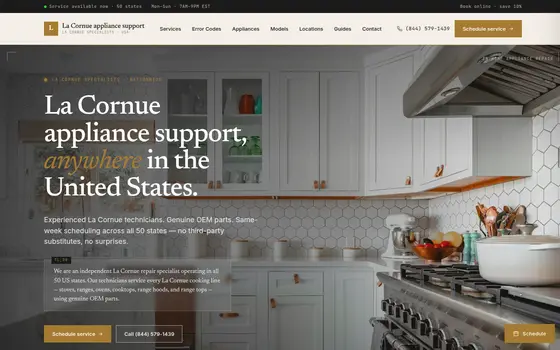
For an independent La Cornue repair service, not affiliated with the manufacturer, we treated the site like a technical manual rather than a brochure: numbered sections, fine rules, serif headlines and figure-style captions in warm brass tones. Behind it, error codes, models, guides and locations are separate content types with their own templates, so editors can expand the library of 101 decoded error codes, 71 listed range models and 50 state pages without redesigning each entry.
On this page7 sections
The brief
The client is an independent specialist repairing La Cornue ranges, ovens and cooktops in the United States. The client is an independent service, not affiliated with the manufacturer. La Cornue ranges are hand-built and expensive, and their owners expect the people who service them to be just as careful.
The site had three jobs: look premium enough to match the appliance, answer very specific technical questions, and still make booking a visit effortless. The full write-up is in the case study; these notes cover the design and content decisions behind it.
An index, not a brochure
Luxury service sites often reach for the same toolkit: dark backgrounds, gold script, large lifestyle photos. We went the other way and borrowed from technical documentation. The layout uses numbered sections, fine rules, serif headlines and figure-style captions, in warm brass tones on a calm background.
The reasoning was simple. The people reading this site already own the product; they do not need to be sold a lifestyle. They need to believe that this service understands their appliance in detail. A design that looks like a carefully set technical manual signals that before the visitor reads anything.
Error codes, decoded
The most valuable content on a repair site is the content that helps before the visit. The site includes a library of 101 error codes and indicator patterns, filterable by appliance type. Each entry explains what the code means and what an owner can safely check, in plain language.
This does two things. Owners who arrive from search with a code on their display find an answer immediately, which builds trust. And it gives search engines and AI answer engines precise, well-structured pages that match exactly what people ask, which is the heart of generative engine optimization.
Models the owner recognizes
A model catalog lists 71 ranges by name and finish, with category filters. For an owner, finding their own range on a service website is a quiet but strong trust signal: these people know what I have. It also gives guides and error codes a natural place to point to.
Locations organized by state
A specialist service often covers a large territory. The site has 50 state pages, so owners and search engines can understand where the service operates. Each should explain the service actually available there and how to confirm availability. The risk with location pages is thin, near-identical content; each page needs to say something useful about service in that area rather than repeating a template with the state name swapped.
A library that grows on its own
Error codes, guides, models and locations are separate content types in WordPress, each with its own template and fields. Adding a new error code or model means filling in a form in the admin, and the entry takes on the existing layout, filters and structured data. Editors can expand the library without redesigning each entry; new fields or functionality still need development.
Independent, and clear about it
Any service website built around a manufacturer’s brand has to be careful. The brand name should identify which appliances are serviced, the business should be described as an independent service, not affiliated with the manufacturer, and wording should never imply manufacturer authorization. That is fair to the manufacturer, honest with customers and a sound basis for search visibility.
If you run a specialist service and want a website that reflects the quality of your work, see our design and UX work or tell us about your business.
Key takeaways
- A precise, consistent design supports credibility; useful, accurate content provides the evidence.
- Specific content, such as decoded error codes and a recognizable model catalog, answers owners’ real questions.
- Separate content types with their own templates let editors grow a library within the existing design.
- An independent service must say clearly, on the site, that it is not affiliated with the manufacturer.
 Case studyLa Cornue Appliance SupportHome services · United States
Related serviceWebsite design & UXDesign & UX
Sources
 Den DyuzhaevFounder & lead developer
Den builds and maintains websites for companies and individual clients in the US and Europe — WordPress on the Roots stack, Laravel, SEO and AI search. Building client websites since 2013.
More about Den